M2 Master Agentic AI in virtual worlds An AI-powered cooking game for sustainable food education

Team

  • Zaynab
  • Ekaterina
  • Konstantin
  • Nele
  • Elisabeth

Supervision

Jonas Ehrhardt, Marino Gabel
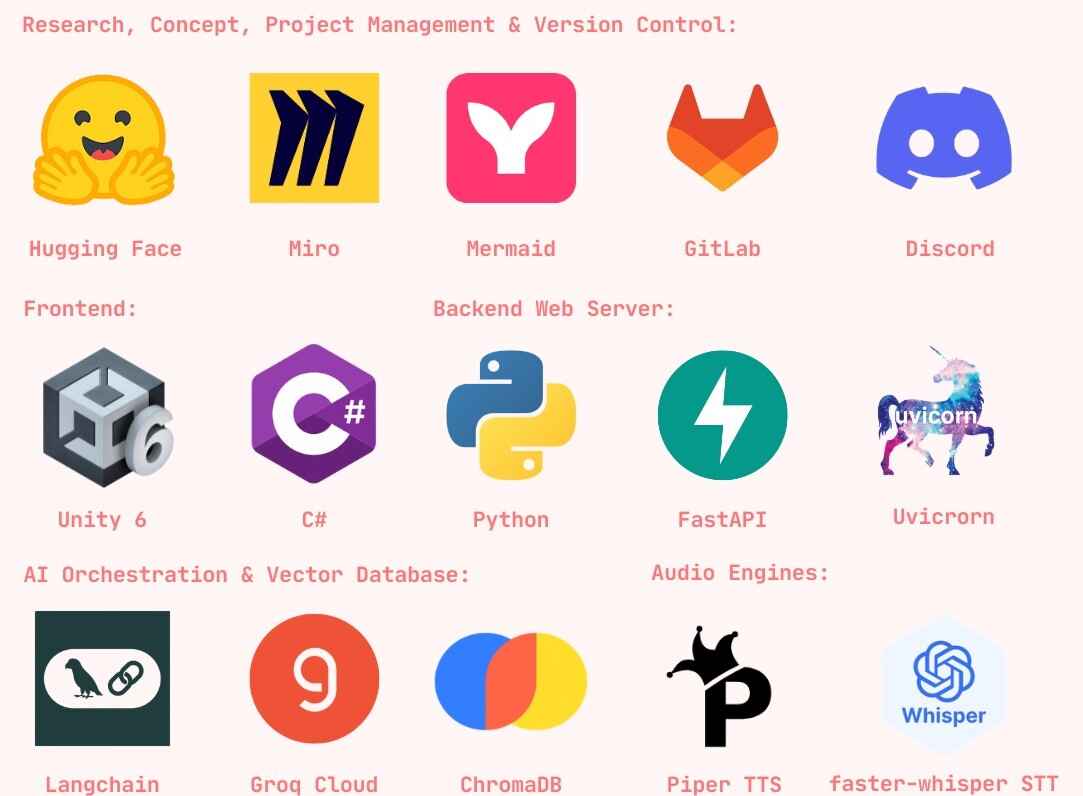
Tech Stack

Concept, Design & Version Control

Miro
Used during the early project phase for collaborative brainstorming, user flow design, concept development, and documenting ideas and design decisions.

Mermaid
Used to create diagrams such as flowcharts, sequence diagrams, and system architecture directly from text-based syntax, making documentation easy to maintain.

Hugging Face
Used to access and integrate pre-trained machine learning models, datasets, and AI tools for natural language processing and other machine learning tasks.

GitLab
Used for version control, collaboration, code reviews, issue tracking, and project management with separate frontend and backend repositories.

Frontend Development

Unity
The game engine used to develop the frontend, including gameplay mechanics, user interface, NPC interactions, and communication with the backend services.

C#
The primary programming language used for frontend development in Unity, implementing game logic, UI behavior and backend communication.

Backend Web Server

FastAPI
Python web framework used to implement the REST API that connects Unity with the AI services, speech processing, and the recipe database.

Uvicorn
ASGI web server used to run the FastAPI application, providing high-performance asynchronous request handling during development and deployment.

Python
Primary programming language used for implementing the backend logic including data handling.

AI Orchestration & Vector Database

ChromaDB
Vector database used for Retrieval-Augmented Generation (RAG). It stores recipe, ingredient, and cooking step embeddings, allowing the language model to retrieve knowledge instead of generating information.

Groq Cloud
Provides access to the Llama 3.1 8B Instant language model used for NPC conversations. Chosen for its low inference latency, enabling responsive real-time dialogue.

LangChain
Framework used to orchestrate prompts, manage conversation flows, integrate retrieval, and maintain session-based memory for the cooking assistant.

Faster-Whisper
Speech-to-text framework based on Whisper. It enables local transcription of player voice input, allowing natural spoken conversations with NPCs.

Piper
Text-to-speech model used to generate NPC voices locally. Different predefined voices are assigned to characters to create distinct personalities while avoiding latency and API costs.